


Moescape - Character AI & Art
Moescape
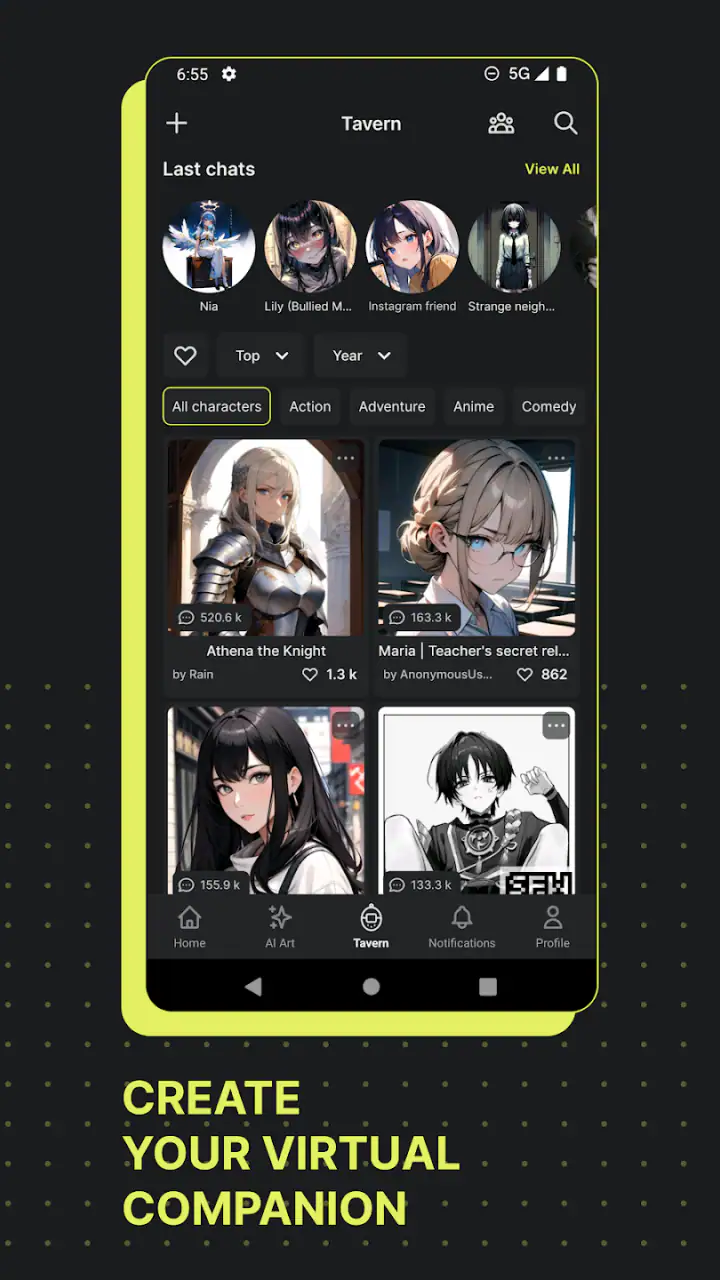
I approached Moescape as an entertainment app for people who want anime-inspired conversations and creative visual experiments in one place. Its focus is AI roleplay, virtual companions, and the creation of images or videos, so it sits somewhere between a character-chat app and a lightweight creative studio. After spending time with that combination, my main impression is that it is more interesting when you treat it as an open-ended playground than when you expect a perfectly consistent story partner.
The app is free to start, which makes it easy to test without committing immediately. It is developed by Moescape and currently carries a 4.4 average from around 9.5 thousand ratings, with more than 500 thousand installs. Those figures suggest that the concept has found an audience, but they do not remove the need to understand how its different parts fit together. The conversational side and the image or video side appeal to slightly different habits, and knowing which one you actually want will make the first session much less confusing.
What the first session feels like, and where people get stuck
The most common difficulty is not necessarily a broken feature. It is the breadth of the experience. A user can arrive wanting a quick anime-style chat, then be presented with character choices, roleplay possibilities, and visual creation ideas. Without a clear personal goal, it is easy to jump between options and leave with the feeling that the app is busy rather than useful.
I recommend beginning with one simple objective: either hold a short conversation with a character or create one visual concept. Trying to evaluate every part at once makes the app feel less coherent. For a first chat, give the character a small situation, a tone, and a boundary. “Help me plan a quiet evening in a fantasy town” is more workable than a vague request to “be interesting.” The same principle applies to visual work: decide whether you are testing a character design, a scene, or motion before you start refining details.
Another point of friction is expectation management. AI roleplay can be engaging, but it is not the same as talking to a human or reading a tightly edited anime script. Characters may respond creatively one moment and lose a detail the next. If you expect perfect continuity, every inconsistency feels like a failure. If you use the exchange as improvisation, those surprises can become part of the appeal.
Related News

Why WhatsApp Messenger Still Makes Everyday Communication Feel Easy

Jurassic World: The Game Is the Better Dino Tycoon for Strategic Players

Threads in Real Life: Who Should Join, Lurk, or Leave

How SHEIN Turned Shopping Into an Endless Content Feed

How to Make Fortnite Feel Smarter on Mobile

Should You Switch to Microsoft Outlook on Mobile?
The visual tools create a similar trade-off. They are attractive for brainstorming, mood boards, and playful experiments, but a generated result may not match the idea in your head on the first attempt. I found that the best results come from treating each prompt as a draft rather than a final commission. Shorter, clearer instructions are usually easier to evaluate than a paragraph packed with conflicting style requests.
Decide what you want from the app before judging it
If your priority is a dependable companion with long-term memory and carefully controlled emotional continuity, this may not be the right first choice. A dedicated companion app can be better at keeping the experience focused. If your priority is polished image editing with precise manual control, a conventional creative editor will probably suit you more. Moescape is strongest for people who enjoy moving between character interaction and imaginative content creation.
It is also aimed at a teen audience, so I would not treat it as a private substitute for professional advice, a trusted adult, or real social support. The entertainment framing matters. I can see the app working well for someone who wants to explore fictional dialogue, invent a character, or turn a story idea into a visual prompt. I would be more cautious about using it to make important personal decisions or to replace meaningful human contact.
Gallery
Setup checks that prevent avoidable frustration
Before blaming the app for a poor first experience, I would check the basics in a deliberate order. The current version is 1.23.0 and it requires Android 10 or later, so an older Android device may be the first obstacle. If the app installs but behaves unpredictably, checking the operating system and updating the app is a sensible starting point. On iOS, the equivalent check is simply making sure the device software and app installation are current.
Next, test the connection with a small action rather than beginning with an ambitious visual request. A short chat message is a better diagnostic than immediately asking for a complicated image or video. If the simple action works, the problem may be related to the size or complexity of the later request rather than the whole service. This saves time and gives you a clearer idea of where the interruption occurs.
It is worth closing other demanding apps before experimenting with visual generation, especially on an older phone. Creative tasks can feel slower when the device is already handling games, video, or many browser tabs. I would also leave enough free storage for normal app operation and generated media. Even when the service does much of the processing remotely, a phone still needs room to cache and display content comfortably.
Notifications and account access deserve a practical check as well. If you expect to return to a conversation or continue a creative idea later, make sure you understand how you are signing in and where your work is being kept. Do not assume that an unfinished prompt, a conversation state, or a generated result will always be recoverable in exactly the same place. Saving important text or downloading a result when the app offers that option is a sensible habit.
The free entry point is helpful, but users should pay attention before spending. In-app purchases range from $4.99 to $359.99 per item, which is a very wide range. I would not buy anything during the first few minutes. First learn what the free experience can do, decide how often you are likely to use the app, and check the purchase screen carefully before confirming. The most expensive option is especially easy to overlook if you are moving quickly through a creative workflow.
A better first-run routine
Start with a short roleplay prompt that names the character’s situation and the kind of response you want.
Read several replies before deciding whether the character’s tone suits you; one unusual answer is not enough evidence.
Move to visual creation only after you know whether you prefer character design, scenery, or story illustration.
Keep your first visual request focused on one subject and one atmosphere, then adjust one detail at a time.
Record prompts you like outside the app so you can reuse the idea instead of reconstructing it from memory.
This routine exposes the app’s strengths without turning the first session into a technical test. It also helps answer a question many new users have: do they need to be good at prompting? Not really, but they do need to describe intent clearly. You can learn through trial and error, yet specific wording makes the results easier to compare and improve.
Recovering a workflow when a chat or creation goes wrong
When a conversation drifts, I would avoid sending a long complaint to the character. A compact correction is usually easier to follow: restate the setting, identify the detail that changed, and say what should happen next. For example, remind the character that the scene is taking place in a train station and that the conversation should remain light. Then continue from there rather than trying to rewrite the entire history.
A useful advanced habit is to keep a small “scene card” in your notes. Include the character’s role, the current location, the relationship between characters, and two or three facts that must remain stable. Paste a shortened version when the exchange begins to wander. This does not guarantee perfect consistency, but it reduces the amount of repetition needed and gives you control over the important parts of the story.
For visual work, change only one variable after an unsatisfying result. If you replace the character, art direction, setting, lighting, and camera idea all at once, you will not know what improved the result. I prefer to preserve the parts that worked and alter the weakest element. This is slower than randomly trying new prompts, but it produces a more understandable workflow and makes the app feel less unpredictable.
If a result appears incomplete or fails to load, first give the app a moment and check whether other content behaves normally. Then retry with a smaller request. Restarting the app can clear a temporary display problem, while switching between a simple chat and a visual request can reveal whether the issue is local to one activity. I would avoid repeatedly tapping a purchase or generation control, because duplicate actions are harder to untangle than a single failed attempt.
Another realistic recovery method is to separate creation from editing in your own process. Use the app to explore a concept, then save the useful wording and continue refining the idea elsewhere if you need exact composition, detailed retouching, or dependable file management. That is not a criticism of Moescape so much as a recognition that an AI entertainment tool and a full production editor serve different purposes.
Use roleplay and visual creation as connected but separate stages
One of the more interesting ways to use the app is to let conversation generate the creative brief. Ask a character to describe a setting, costume, or emotional moment, then turn the strongest details into a visual prompt. This gives the image a narrative reason to exist instead of producing disconnected anime-style pictures. The reverse also works: create a visual idea first, then ask a character to explain what happened just before or after the scene.
The trade-off is that the two stages may not preserve every detail automatically. I would copy the essential description manually rather than assuming the visual tool will understand the entire roleplay context. Keep names, colors, clothing, and setting details in a short note. This is a non-obvious but valuable safeguard when you want a series of related scenes rather than unrelated experiments.
For an everyday example, imagine having twenty minutes after school or work and wanting something creative without opening a full desktop editor. I might ask a companion to help invent a small mystery in a seaside town, use the conversation to define the main character, and then create one atmospheric scene from the resulting description. If the first visual is off, I would keep the story idea, adjust the prompt, and stop after a few iterations rather than spending money simply to chase perfection.
That workflow also clarifies who will enjoy the app. It suits people who like improvisation, anime aesthetics, character writing, and quick visual exploration. It is less suitable for someone who wants a fixed game with clear objectives, a social network built around real friends, or a professional animation pipeline. The entertainment category is not incidental; the app rewards curiosity more than efficiency.
When the app is not the cause of the problem
Some frustrations come from the phone, the network, or the user’s expectations rather than from Moescape itself. A weak connection can interrupt cloud-based interactions, while an older device can make media-heavy tasks feel sluggish. If text works but images or videos struggle, that distinction matters. It points toward a heavier creative operation, not necessarily a complete app failure.
Storage can also become a hidden issue. Generated media is easy to accumulate because each result feels worth keeping for a moment. After a few sessions, the gallery or device may become cluttered, making it harder to find the version you actually liked. I recommend naming or organizing saved results outside the app as soon as they become part of a project. This is particularly useful if you are building a character reference or a sequence of scenes.
There is also a human factor: prompts often contain incompatible instructions. Asking for a quiet, minimal scene with a crowded festival, dramatic action, and several competing subjects gives the system too many priorities. When the result looks wrong, simplify the request before concluding that the generator is unreliable. A clear subject, setting, mood, and visual emphasis are a better starting point than a long list of adjectives.
Privacy and emotional boundaries deserve common sense. Do not place sensitive personal information into fictional conversations simply because the interface feels private. Likewise, remember that a convincing reply is generated entertainment, not proof of understanding or personal concern. I found the experience more enjoyable when I treated characters as creative partners for a scene, while keeping real decisions and vulnerable conversations in the human world.
Age suitability matters too. The Teen rating means parents and younger users should consider whether the roleplay themes and generated material fit their expectations. I would encourage families to discuss responsible use, spending controls, and the difference between fictional interaction and real relationships. That conversation is more useful than assuming an AI character will automatically provide appropriate guidance in every situation.
How it compares with familiar alternatives
Compared with a standard chatbot, Moescape has a stronger anime and roleplay identity, plus a visual side that makes the interaction feel more creative. A general chatbot may be better for research, practical writing, or broad subject coverage. Compared with a dedicated AI companion service, Moescape feels less narrowly focused because images and videos are part of the attraction. A companion-first product may feel more consistent if daily conversation is your only goal.
Against ordinary image-generation apps, its conversational setting is the main distinction. You can develop an idea through character dialogue instead of writing every concept from scratch. The compromise is that users looking for detailed manual control, professional asset organization, or predictable editing may prefer a specialized art tool. Moescape is best understood as a bridge between roleplay and visual experimentation, not a replacement for every app in either category.
That comparison answers another practical question: is it worth paying? For occasional curiosity, I would stay with the free experience until the workflow becomes part of your routine. Payment makes more sense only when you know which activity you repeat and what limitation you are trying to overcome. Because individual purchases can be substantial, I would set a personal spending limit before exploring premium options rather than making an impulse decision after an attractive result.
My practical verdict after using the whole concept
Moescape is a distinctive entertainment app because it connects AI anime roleplay, virtual companions, and image or video creation without forcing you to choose just one creative mode. I enjoyed it most when I arrived with a small idea and allowed the app to help me expand it. The strongest results came from short prompts, manual continuity notes, and a willingness to treat generated content as a draft.
It is not frictionless. New users may need time to understand where to begin, conversations can lose details, visual results may require several attempts, and the wide range of in-app purchase amounts calls for care. Those limitations matter if you want dependable long-form storytelling, exact visual control, or a serious productivity tool. They matter less if you enjoy experimentation and do not mind guiding the process.
The app was released on September 23, 2024, and its current version is 1.23.0, so keeping it updated is a sensible part of maintaining a smooth experience. It is free to try, rated for teens, and available as an entertainment-focused way to explore fictional characters and AI-assisted media. I would recommend it to creative users who want a low-pressure space for anime-inspired ideas, especially those willing to save useful prompts and refine results patiently.
My recommendation is to begin slowly, test one conversation and one visual workflow, and delay any purchase until you understand your actual usage. If that process feels enjoyable rather than tedious, Moescape can become a fun source of story prompts, character scenes, and visual inspiration. If you need precise production tools or emotionally reliable companionship, choose a more specialized alternative instead. For the right person, its value is not in replacing those tools, but in making the jump from imagination to an interactive anime-style concept unusually easy.
FAQs for Moescape - Character AI & Art
What is Moescape - Character AI & Art?
Moescape - Character AI & Art is an AI-powered creative platform focused on interactive character conversations and image generation. Users can chat with existing characters, create their own personalities, and explore AI-generated artwork. The experience is designed for entertainment, storytelling, roleplay, and creative experimentation rather than factual advice or professional communication.
Can I create my own AI characters in Moescape?
Yes, Moescape generally allows users to design custom AI characters by defining details such as a name, personality, background, appearance, and conversation style. The quality of the interaction depends heavily on how clearly these instructions are written. Users should also review the platform’s community and content rules before publishing characters or sharing them with others.
Does Moescape generate AI images as well as text conversations?
Moescape combines character-based chat with AI art features, allowing users to request or create images based on prompts and creative ideas. Results can vary depending on the wording of the prompt, selected style, and available generation settings. Some advanced tools, higher usage limits, or specific image options may require credits, a subscription, or other in-app purchases.
Is Moescape free to download and use?
The app may be available to download without an upfront charge, but free access can include limits on messages, image generations, character features, or daily usage. Certain functions may be supported through virtual credits, advertising, or premium plans. Before spending money, check the current pricing, renewal terms, and whether subscriptions are managed through Google Play or the Apple App Store.
Is Moescape suitable for children and is my data private?
Parents should check the current age rating and content policy before allowing younger users to access Moescape. AI character platforms can include mature themes, user-created content, and conversations that are not appropriate for every audience. Avoid sharing sensitive personal information, and review the privacy policy to understand how chats, prompts, account details, and generated content may be stored or processed.
Pros
- Offers creative character interactions for roleplay and storytelling.
- AI-generated art adds a visual element to conversations.
- Large variety of community-created characters to explore.
- Useful for brainstorming plots
- dialogue
- and original ideas.
- Personalized chats can become more engaging over time.
Cons
- Some characters may produce repetitive or inconsistent replies.
- Generated images can occasionally miss requested details.
- Advanced features may require a subscription or paid credits.
- Content quality varies widely between community-created characters.
- AI responses may include unexpected or unsuitable themes.


